

Choosing to downsize, move, or simplify is, without question, not something you need to feel guilty about. It is empowering! Phase two isn’t about selling your home (yet). It’s about getting things in order so that when it is time, you are prepared, confident, and still in control.
For many people, this phase begins once they realize one or more of the following:
- You’re still independent, but laundry, bedrooms, and living spaces spread across multiple floors have become exhausting or inconvenient.
- Your home requires constant upkeep, mowing, snow and ice removal, cleaning, and you’re simply over it.
- The house is just too big. Realistically, you have realized you are only using a handful of rooms.
- You’re thinking ahead and considering a senior community that offers a different kind of independence: transportation, social connection, security, and the comfort of knowing you won’t need to move again if your needs change.
Let me be clear, the decision to move is one of the thoughtful, proactive, and freeing decisions they make.
Why?
Because:
- You are making the decision to move when you are still the one making decisions.
- You are removing stress, fear, and anxiety from your family!
- You get to decide where you go, what your next home looks like, and how you want to live.
- You can choose a space that’s easier to age in place—or one that offers a continuum of care if independence changes over time.
According to AARP and Age Wave, roughly 50–60% of adults age 55+ say they expect to downsize at some point. Many feel this way because of maintenance requirements, safety concerns, finances, or because of the desire for an easier day-to-day life. Most importantly, they do not want to move because of a crisis or emergency.
Preparing is empowering. Let’s get started.
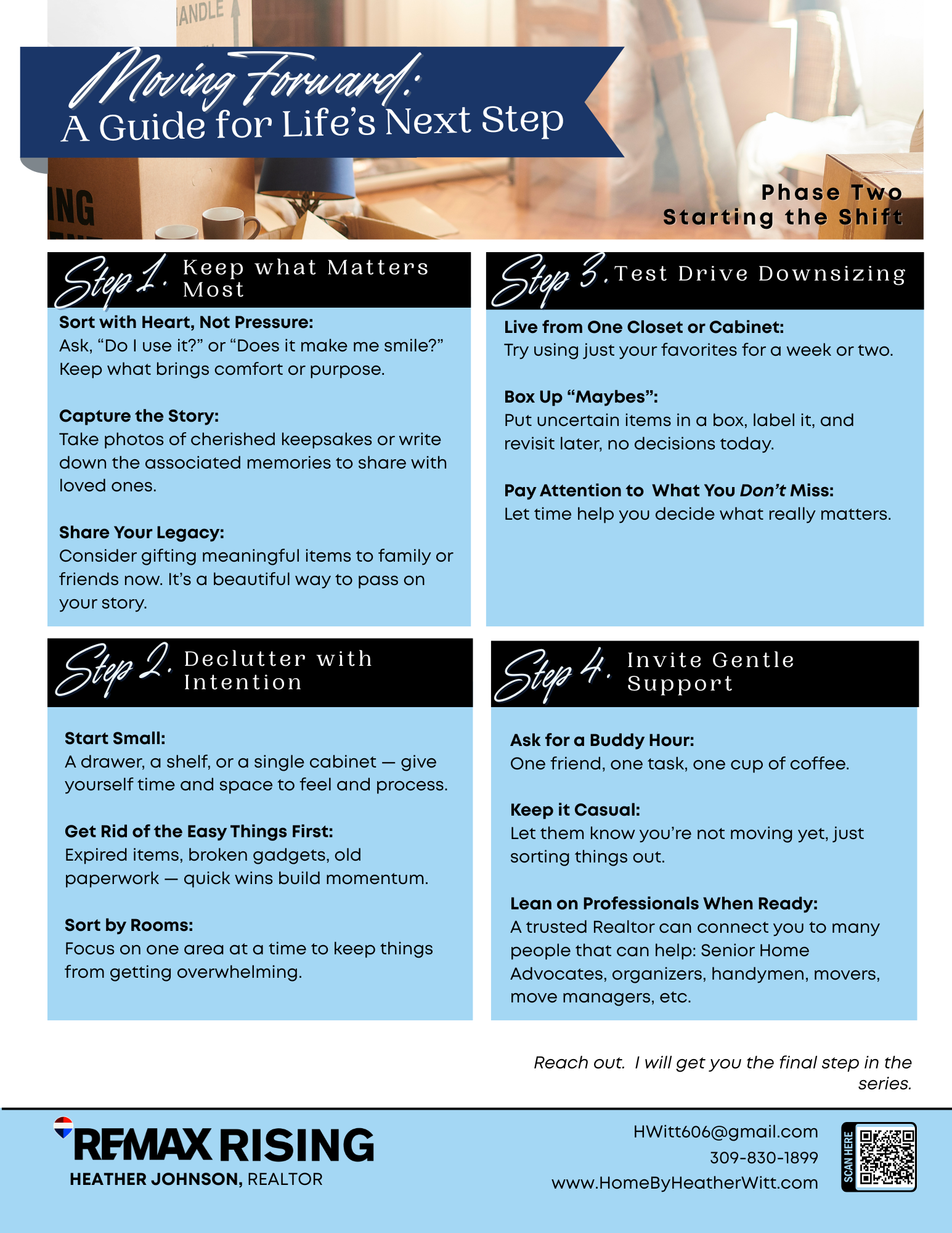
Step 1: Keep what matters most.
Keep it objective, not emotional.
Research from UCLA’s Center on Everyday Lives of Families (CELF), including Life at Home in the Twenty-First Century, found that people often overestimate the value of possessions to future generations, while underestimating the stress those items can create.
Your memories, feelings, and intentions are good. But many children will smile and say, “Of course we want that,” while quietly worrying about where it will go, how to store it, or what to do with it later.
Instead of asking, “Should I get rid of this?”, ask yourself:
- Do I use this?
- Does this make me happy, or comfort me?
Remember: photos and stories matter just as much as physical items. Taking a picture or writing down the memory preserves the meaning—without the burden of keeping everything.
Step 2: Get to work.
Start embarrassingly small: one drawer, one shelf, one cabinet.
Start with easy wins:
- Expired items
- Broken things
- Paperwork you no longer need
- Items missing parts
- Duplicates (scissors, mugs, utensils)
- Clothes and shoes you no longer wear
- Old purses or bags
- Extra baskets
- Excess sheets or blankets
- Worn towels
- Books and magazines you’ll never reread
Starting with easy things gives you a boost to keep going and feel like you are accomplishing something.
Step 3: Practice Living With Less
This step is powerful and surprisingly comforting.
The goal isn’t to make permanent decisions.
The goal is to notice what you actually use, enjoy, and miss (or don’t).
Think of this as an experiment.
For the next month, try one of these a week (or, more than one if you are really looking for a challenge):
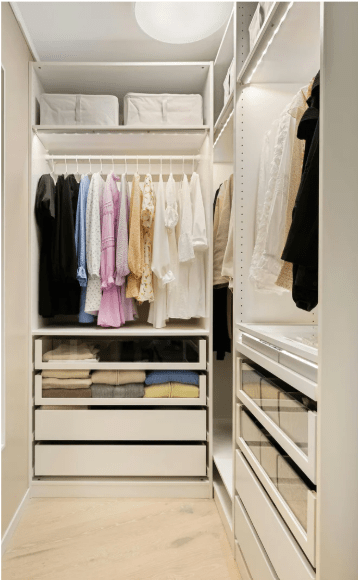
Option 1: The Closet Trial
For one week, only wear:
- Your favorite, most comfortable clothes.
- The items you immediately reach for, no overthinking!
At the end of the week, ask yourself:
- Did getting dressed feel easier?
- What did I wear repeatedly?
- What didn’t I even consider wearing?
Option 2: The Kitchen Trial
When you decide to simplify and downsize, your kitchen footprint will likely shrink. To prepare for this, try the following for one week.
For one week, limit yourself to:
- One upper cabinet
- One lower cabinet
- Two drawers
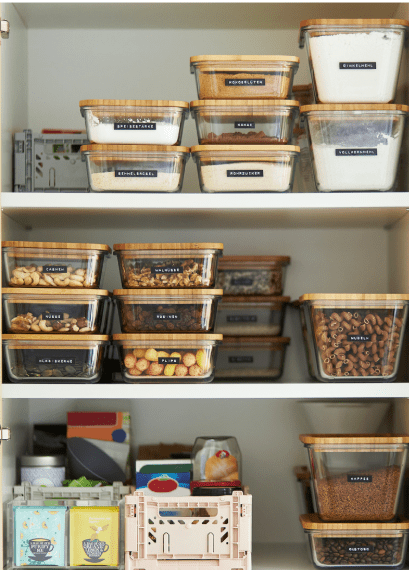
- In one, put your favorite dishes, cups, coffee mugs, storage containers, ect.
- In a second, put basic food items you use on a regular basis: seasonings, oils, coffee, and shelf-stable items like soup or pastas.
- In a third, put your most essential posts and pans as well as storage items.
- In the fourth cabinet, stick bigger items you use regularly: toaster, blender, coffee pot, etc.
- In the drawers, silverware and your favorite cooking utensils.
When the week is over, notice:
- Did cooking feel simpler or more frustrating?
- Did you truly miss anything?
- Did the cleanup feel easier?
- Did the space feel calmer?
Option 3: The Room Reset
Think Tiny House Nation, without going that extreme (if you haven’t watched it, check it out. It’s one of my faves).
The living room works best.
If moving furniture isn’t safe, simply cover or remove smaller items.
NOTE: If lifting or moving furniture isn’t safe, simply cover it and remove smaller items instead.
For one week:
- Remove furniture you don’t use daily.
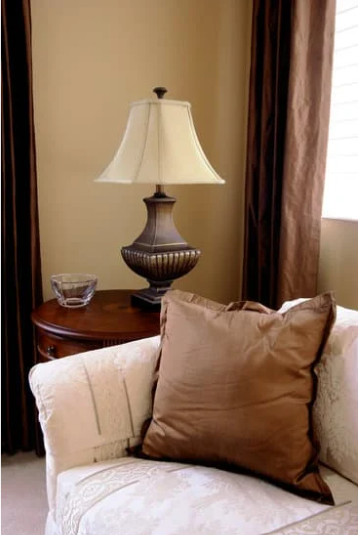
- Keep one end table and a coffee table.
- Hide or move the non-essential things from your side tables.
- Cover your bookshelves or display cases to mimic them being gone.
- Remove oversized items blocking walkways or disrupting flow.
At the end of the week, think about these things:
- Does the room feel calmer?
- Is it easier to move through?
- Do I feel less mentally “busy”?
- Do I miss what I removed?
Most people are surprised by how little they miss, and how much more calming the space feels.
If it’s helpful, I’ve put together a simple, room-by-room list to make it easier to know where to start. Request a copy here.
Step 4: Open up the dialogue and ask for support.
This part of the process isn’t just physical work; it can be heavily emotional as well.
Invite others into the process who you trust to keep you company, not judge you, and know you want support, not a manager. It’s a time for connection, perspective, and support.
How can involving others help?
- Friends and family can lightly distract your mind, helping you work through memories without getting stuck or spiraling,
- A second set of hands can help put things where they belong (so you don’t get off track or overwhelmed),
- Talking through memories out loud can be fun, healing, and remind you that the moments matter more than the objects,
- Most importantly, you’re reminded that you’re not alone in this process.
And honestly, being with friends or family is usually enjoyable.
Feeling overwhelmed?
That’s normal. This shouldn’t feel rushed; the intent is to help you ease into a new situation.
Sometimes the most helpful thing is simply having someone walk through the house with you, not to make decisions, but to talk through the thoughts, feelings, and process.
Through my real estate work, I’ve built relationships with organizers, movers, and professionals who focus specifically on helping older adults simplify and plan. These are people I know and trust, and I’m happy to connect you when questions come up.
These have become people I know personally and trust. If questions come up, I can help introduce you.
What’s next?
In the final phase of my Senior Series, we’ll get more specific.
You’ll find a clear, manageable list of what to do when you are ready to sell: what needs attention, who can help, and how to prepare without overwhelm.
I’ve created a worksheet you can use to walk through these questions at your own pace.
Some people to work through them alone; others like to work through it with someone they trust.
Send me an email at HWitt606@gmail.com. I can send one you can print, or I’m happy to drop one off.
When that time comes, I would be honored to walk that path with you.
I’ve seen how difficult these decisions can be, especially for people who have built a lifetime in one home. I care deeply about the stories people share and what their homes represent. I’ve often wished this kind of support had existed sooner for people I love.



 Heather Johnson - Home in the Chaos
Leave a comment